
A Fence That Lives
For three years now, I’ve used log pole fencing to hold the livestock.
It served its purpose well — strong, straightforward, dependable. But wood, once cut, begins its slow return to the soil. The posts are aging now. The rails will not last forever.
And rather than replacing dead wood with more dead wood…
I’ve decided to grow a fence instead.
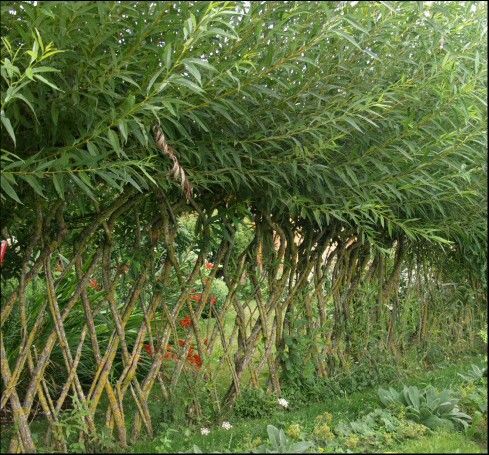
A living woven willow fence.
Not just a barrier — but a boundary that roots, grows, and feeds.
Why Willow?
Willow is one of the most generous trees I know.
- It roots easily from cuttings
- It grows fast — sometimes several feet per season
- It tolerates cold, wind, and poor soil
- It bends without breaking
- And the goats love to browse the tender tops
What if the very thing that keeps them in… also nourishes them?
That’s the kind of system I’m trying to build here. Not separation — but symbiosis.
“And the tree of the field shall yield her fruit, and the earth shall yield her increase.”
— Ezekiel 34:27 (KJV)
The Process: Planting a Living Fence
1️⃣ Harvesting Cuttings
In early spring (while dormant), I’ll take straight willow rods:
- 6–8 feet long
- Thumb-thick or slightly larger
- Freshly cut
The lower ends will be cut on an angle to encourage rooting.
2️⃣ Setting the Line
Instead of posts and rails, the posts are the fence.
- Drive willow rods 12–18 inches into moist soil
- Space roughly 8–12 inches apart
- Stagger slightly for density
Water deeply after planting.
Within weeks, they’ll leaf out.
Within months, they’ll begin to root strongly.
3️⃣ Weaving the Living Wall
As new shoots grow:
- Bend and weave neighboring rods together
- Cross them in a lattice pattern
- Tie temporarily if needed
Over time, the branches graft and fuse naturally where they touch — forming a solid living structure.
The result is not just fencing.
It’s a woven hedge, dense and resilient.
Benefits for Livestock
- Goats can browse the upper growth
- Fresh willow supports rumen health
- Natural enrichment reduces boredom
- The fence regenerates after browsing
Instead of replacing boards, I’ll be pruning growth.
Instead of decay, there’s renewal.
Ecological Benefits
- Roots stabilize soil
- Increased biodiversity
- Shade and windbreak
- Habitat for birds and pollinators
It becomes part of the land instead of something imposed upon it.
“The righteous shall flourish like the palm tree: he shall grow like a cedar in Lebanon.”
— Psalm 92:12 (KJV)
Growth is stronger than force.
Maintenance & Expectations
A living fence requires:
- Seasonal pruning
- Patience the first 1–2 years
- Protection from overgrazing while establishing
But once mature?
It can last generations.
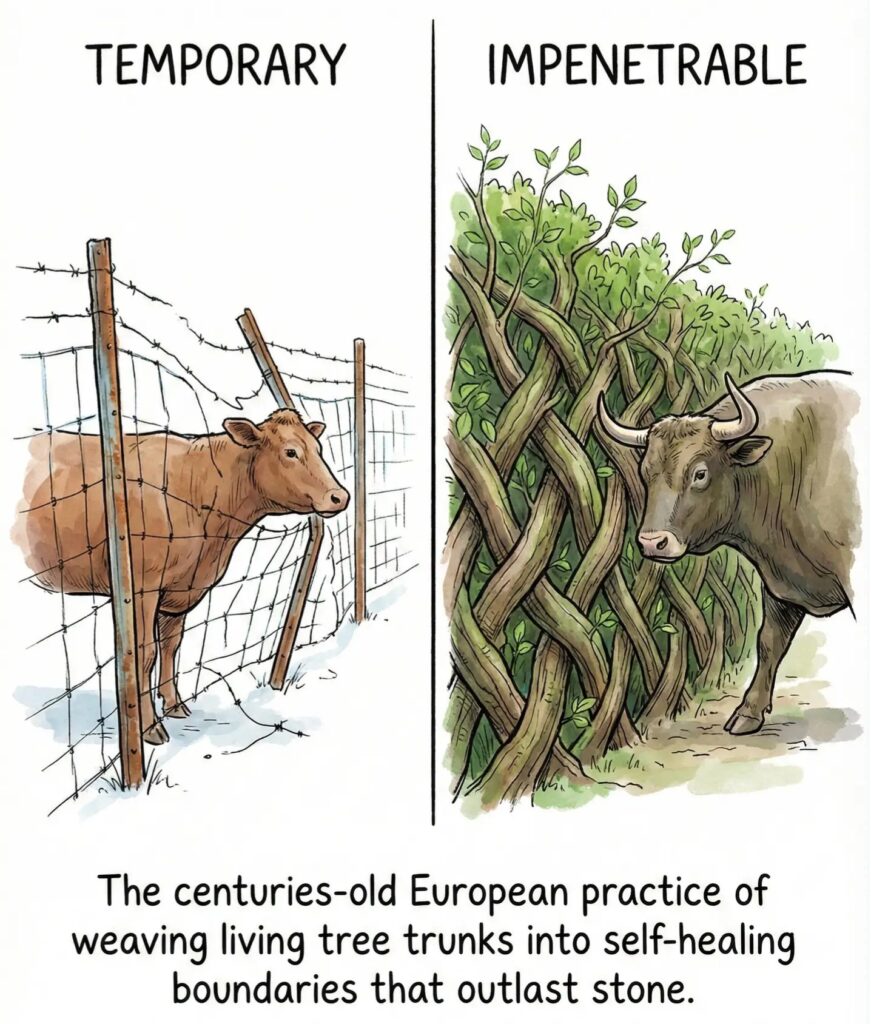
Unlike log poles that slowly rot, this fence strengthens over time.
A Different Kind of Boundary
There’s something poetic about a fence that feeds the very animals it contains.
A boundary that doesn’t just divide — but gives.
That’s what I want WoodFrog Hollow to become.
Not a collection of structures… but a network of living systems.
“They shall build houses, and inhabit them; and they shall plant vineyards, and eat the fruit of them.”
— Isaiah 65:21 (KJV)
A house that feeds.
A fence that grows.
A land that sustains.
What we plant in faith, we will one day harvest in strength.
🌿 Living Woven Willow Fence
Step-by-step planting & weaving guide (with simple diagrams)
What you’re building
A row of live willow “posts” that root in place, then get woven into a lattice as they grow—forming a dense, flexible fence that can also provide goat browse up top.
0) Materials checklist
Tools
- Loppers/pruners + small saw
- Post driver / heavy mallet (or digging bar)
- Tape measure + stakes + string line
- Bucket/tote for soaking cuttings
- Gloves
Supplies
- Willow cuttings/rods (live, dormant)
- Mulch (wood chips/straw)
- Temporary ties (jute twine / soft tree tape)
- Optional: temporary livestock barrier (netting/panels) for year 1
1) Pick the fence line (and choose the right willow)
Best location
- Moist soil is ideal (willow loves water)
- Full sun to partial sun
- Avoid places that dry out hard in summer unless you can water
Willow species Use whatever local willow thrives in your area (the “right” willow is the one that survives your winters and roots easily).
2) Harvest your rods at the right time
Best timing: late winter / early spring while dormant (before leaf-out)
Target cutting size
- Length: 6–8 ft (long enough to weave and gain height)
- Thickness: thumb-thick is a great baseline
- Straight-ish rods are easiest to weave
How to cut
- Bottom cut: angled (helps you remember which end goes down)
- Top cut: flat (helps you remember which end is up)
Diagram: rod ends
TOP (flat)     BOTTOM (angled)
   ____           /
  |____|         /
               _/
3) Soak the cuttings (strongly recommended)
Soak the bottom 1/3 of rods in clean water for 24–72 hours.
This improves early rooting—especially if conditions are dry or windy.
4) Set your spacing and layout
Two common layouts:
Option A: Single row (simpler)
- Space rods 8–12 inches apart
Option B: Double row (stronger, denser)
- Two parallel rows 8–12 inches apart
- Stagger rods like a zipper
Diagram: spacing
Single row (top view):
| 8-12" | 8-12" | 8-12" |
   O       O       O

Double row (staggered top view):
Row 1:   O     O     O
Row 2:     O     O     O
Distance between rows: 8-12"
5) Plant the rods deep enough to root
Depth
- Drive each rod 12–18 inches into the soil
(deeper is better in sandy soil)
Angle
- For weaving, it helps to plant rods slightly angled:
- Some leaning left, some leaning right
Diagram: alternating angles (side view)
Fence line:
 \  /  \  /  \  /
  \/    \/    \/
 (roots set 12-18" deep)
Pro tip: If the soil is hard, use a digging bar to make a starter hole.
6) Water and mulch immediately
- Water deeply right after planting
- Apply mulch along the line (but keep it off the rod stems) I will be using the spent rabbit bedding as mulch for this job.
This keeps soil moisture consistent—huge for success.
7) First weave (when rods are flexible and awake)
When: once rods have leafed out and are bending without cracking
(often late spring / early summer)
Basic weave method
- Pick two neighboring rods.
- Bend them toward each other.
- Cross them and continue crossing down the line.
Diagram: simple lattice (front view)
Before weaving:
| | | | | | |

After weaving:
X X X X X X X
How to secure
- Use a soft tie at key crossing points at first
- In time, willows often “set” into position
8) Second weave (thickening the wall)
When: later in the same season or the next spring
You’ll use newer side shoots to fill gaps and thicken.
Goal: fewer holes, more density.
Diagram: thickening with side shoots
Main rods:     X   X   X
Side shoots:  /|\ /|\ /|\
Result: denser living wall
9) Training the “browse zone” for goats
This is the trick that makes it both fence + feed.
Establishment rule (Year 1)
Protect the fence from goats until it’s rooted and growing strongly.
Use:
- temporary netting inside the line, or
- panels, or
- a “sacrificial browse lane” outside the fence
Browse zone strategy (Year 2+)
- Let goats nibble the top growth only
- Keep the lower fence dense and protected
Diagram: browse zone
Top = browse
=================  <-- goats can reach
Fence structure
XXXXXXXXXXXXXXX
XXXXXXXXXXXXXXX  <-- keep dense; protect if needed
Ground
---------------
10) Seasonal maintenance schedule (simple)
Spring
- Re-tie crossings if needed
- Plant replacements where a rod failed
Summer
- Water during drought
- Weave new flexible growth
- Light prune to encourage side branching
Fall
- Prune for shape
- Remove weak/crossing growth that opens holes
Winter
- Harvest rods for expansion/repairs (dormant cutting season)
Troubleshooting quick guide
Problem: rods didn’t leaf out
- Likely not alive, planted upside down, too dry, or not deep enough
Fix: replace, soak longer, plant deeper, water more consistently
Problem: leaves appear but growth is weak
- Not enough sun/water, or soil too poor
Fix: mulch + water + consider compost around the line
Problem: fence is “see-through”
- Not enough density or weaving rounds
Fix: add a second row, encourage side shoots, weave again next season
Problem: goats destroy it
- Fence wasn’t protected long enough
Fix: protect base for another season; only allow top browsing later
Living Willow Fence Recipe
- Cut 6–8 ft dormant willow rods (thumb-thick)
- Soak 24–72 hrs
- Plant 12–18″ deep, 8–12″ apart (single or double row)
- Water + mulch
- Start weaving once flexible
- Protect from goats until established
- Maintain by weaving/pruning yearly